
Services
Trauma therapy for multicultural and LGBTQIA2S+ folks who want to embody self-trust, belonging, and connection.
Holistic Therapy that honors your whole story
Perhaps you're feeling alienated, empty, or disconnected. Maybe you’re struggling to know who you are and where you belong. It could be difficult to hold onto your boundaries and advocate for yourself. Maybe it’s hard to trust yourself and others. Past memories and trauma might be creeping into your present as nightmares, endless worry, or a pervasive fear of what might go wrong. Unaddressed pains can show up as anxiety, depression, trauma, harmful relationships, and self-criticism. You might feel stuck and overwhelmed on how to move forward.
Therapy is a place where we can get to the root of these challenges for you to reconnect with yourself and cultivate an embodied sense of safety. We can work together to better understand how your past influences your present and move towards shaping a future that’s rooted in your values. Therapy can offer space for honoring your lived experiences and getting to know who you are beneath the survival strategies. Whether it’s untangling stories that no longer serve you or facing fears that are holding you back, I work with you to reclaim your voice and restore your autonomy.
I strive to co-create a space where you can authentically express yourself and safely explore your inner world. I am collaborative in my approach and will tailor our sessions to address your unique needs and goals. I integrate varying evidence-based modalities, including EMDR, IFS (parts work), somatic therapy (body-oriented approach), DBT, and CBT.
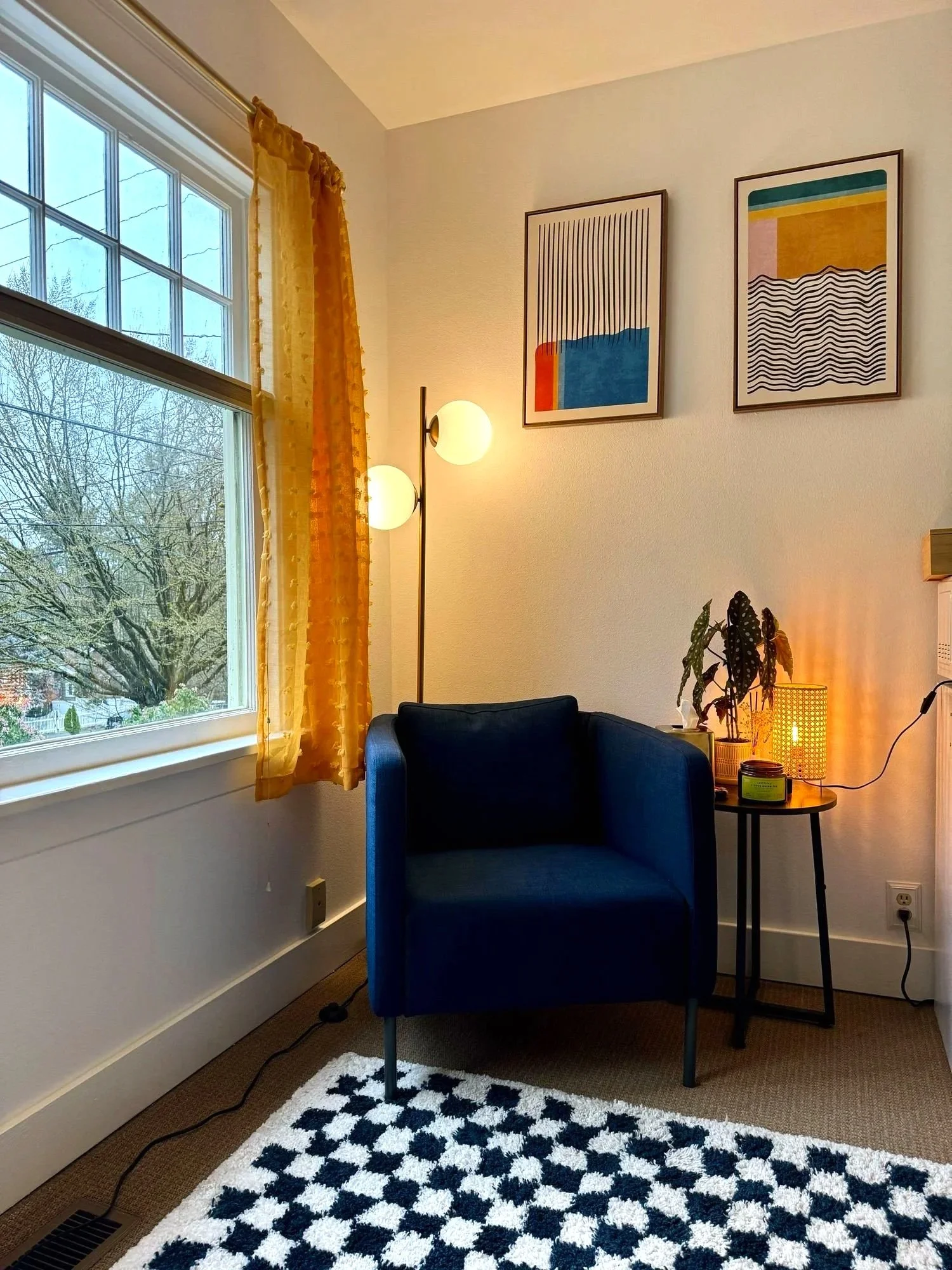
I work with adult individuals ages 18 and older. I offer in-person sessions in the Ravenna neighborhood of Seattle and virtual sessions to people across Washington state.


Walk & Talk Therapy
I additionally offer walk and talk therapy near Ravenna park. For those interested in pairing therapy with a nature walk, this might be a good fit for you.

“Healing is a reminder of what we already are and what we have always been part of.”
— Resmaa Menakem
Treatment Modalities
Holistic approaches that support your healing and growth.
Eye Movement Desensitization & Reprocessing (EMDR)
EMDR helps the brain process overwhelming experiences to reduce the emotional charge they carry. This can be helpful for working with painful memories, trauma, or severe anxiety that feels “stuck” in the body. Reprocessing memories can help lower the intensity of emotional and physical responses, teach your body where there is safety in the present, and build more adaptive beliefs.
Internal family systems (IFS)
All parts of you are welcome.
IFS is a non-pathological approach that honors your multitudes and seeks to build capacity for being present with yourself and the complexities of your experiences. This can be supportive for better understanding how you’ve made sense of the past and learned to navigate the world. We can move towards creating more peace in your inner world by working through conflicting experiences and cultivating more compassion towards different parts of yourself.
Somatic therapy
Learn to reconnect with yourself and your body in ways that feel safe. Somatic therapy helps build an understanding of how your body stores experiences/memories and carries the impact of past challenges or trauma. This can be supportive for better attuning to your internal and physical experiences, while developing tools to help calm your body and regulate emotions when needed. Work on strengthening the mind-body connection to address how anxiety and trauma are stored in your body, instead of solely relying on ways to to think your way out of a physical/emotional reaction.
Dialectical Behavior Therapy (DBT)
Dialectical means recognizing that seemingly opposite realities can both be true at the same time, and emphasizes creating a middle ground to integrate those co-existing truths. DBT Is an approach that balances both acceptance and meaningful change. This is a skills-focused approach that helps develop tools for improving mindfulness, distress tolerance, emotion regulation, and interpersonal effectiveness.
Cognitive Behavioral Therapy (CBT)
Understand how your thoughts, feelings, and behaviors are interconnected. CBT helps with identifying and shifting patterns of thinking, related emotions, and subsequent actions that are no longer serving you. This might include interrupting thought spirals, checking underlying assumptions, and developing more compassionate self-talk.
Getting started
At the beginning, we’ll focus on building a foundation of trust and safety, while creating a metaphorical map that will guide our work together. This might include exploring your past (roads previously traveled), your present (where you are now), and your future goals (where you want to go).
What brings you to therapy?
What’s going on in your world now?
What’s your relationship with yourself like?
What are your core values and what’s important to you in life?
❋ Roads traveled
❋ current location
What has shaped your lived experiences and wellbeing?
How has your past influenced you?
What has previously worked for you and been supportive in your healing journey?
What are your therapeutic goals?
What changes do you want in your life?
What are the first steps to moving closer to your goals?
❋ Destinations